How a Florida Roofing Contractor Handled a $250K Liability Claim With Proper Coverage
A single roofing installation error can generate a liability claim large enough to bankrupt a small contracting business. In Florida, where hurricanes, heavy rain, and extreme heat amplify property damage risks, roofing contractors face some of the highest liability exposure in the construction trades.
Need
Business Insurance ?
Get a Quote
This roofing liability claim case study examines how a Florida-based roofing contractor survived a $250,000 property damage claim after a residential roof installation caused significant water intrusion. The contractor’s general liability policy covered the claim in full, preserving both the business and its reputation.
Without that coverage, the outcome would have been catastrophic. The following breakdown details what happened, how the policy responded, what the contractor paid in premiums versus what the insurer covered, and the concrete lessons every roofing contractor operating in Florida should take from this scenario.
The Claim: $250K Property Damage From a Roof Installation Gone Wrong
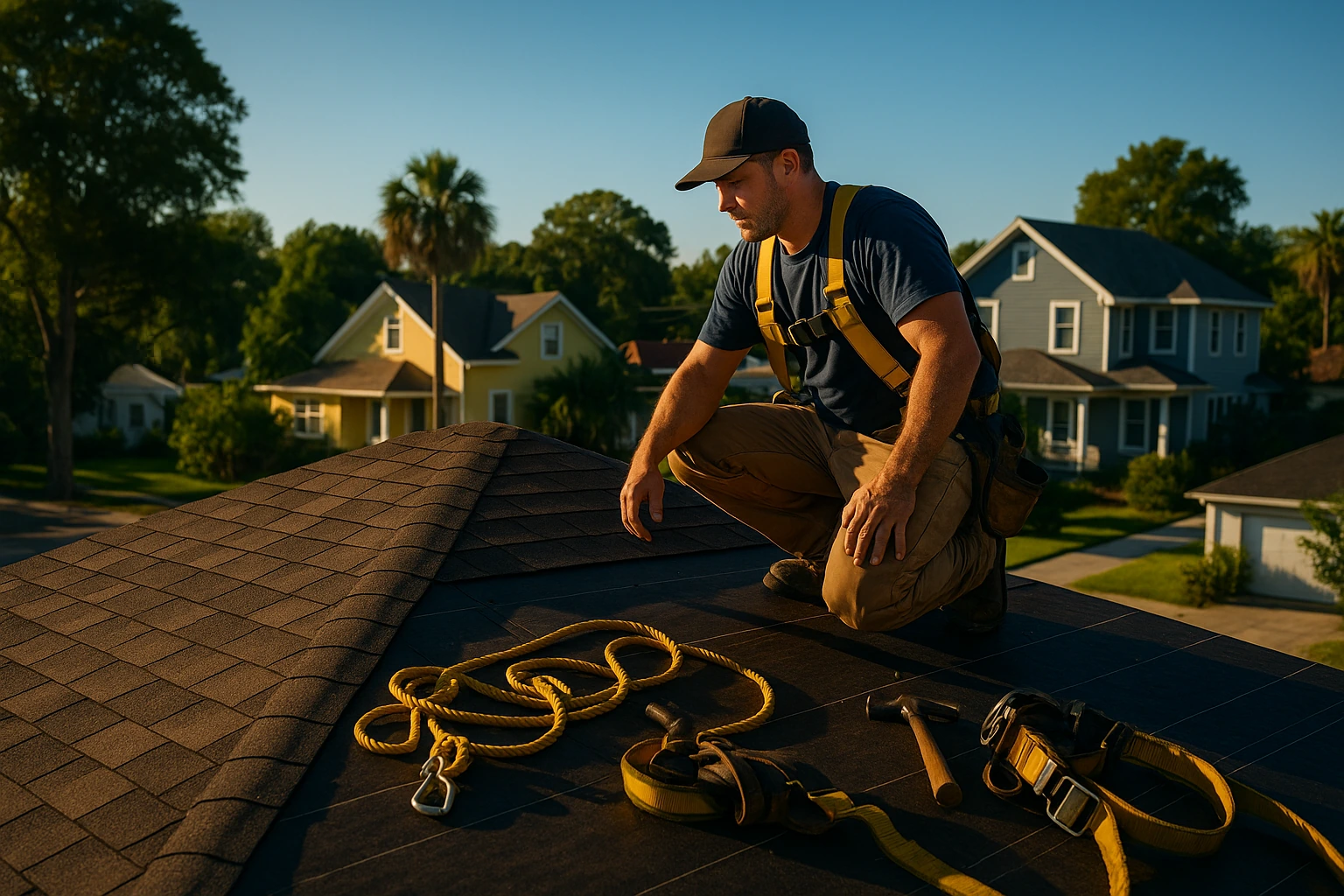
The contractor-a licensed roofing company with eight employees operating in the Tampa Bay area-was hired to replace a tile roof on a 3,200-square-foot residential property. The scope included full tear-off, new underlayment, and installation of concrete barrel tiles.
During the installation, the crew improperly sealed the flashing around a dormer and failed to install a secondary water barrier as required by the Florida Building Code (Section R905.2.7). Two weeks after the project was completed, a heavy rainstorm drove water behind the flashing, through the roof deck, and into the home’s interior.
The resulting damage included:
- Saturated ceiling drywall in three rooms, requiring full replacement
- Mold growth behind interior walls, detected within 30 days
- Warped hardwood flooring throughout the main living area
- Damage to personal property, including furniture and electronics
- Temporary relocation costs for the homeowner during remediation
The homeowner filed a claim against the roofing contractor for $250,000 in damages. An independent adjuster confirmed that the faulty flashing installation was the direct cause of the water intrusion. This roofing liability claim case study highlights a scenario that plays out across Florida dozens of times each year-routine workmanship errors escalating into six-figure claims.
Coverage That Saved the Business: GL Policy Breakdown
The contractor carried a General Liability Insurance policy with a $1 million per-occurrence limit and a $2 million aggregate limit. The policy was written on an occurrence form (ISO CG 00 01), which is the standard commercial general liability form used across the insurance industry.
How the GL Policy Responded to the Claim
The general liability policy covered this claim under “Coverage A: Bodily Injury and Property Damage Liability.” Specifically, the damage qualified as property damage caused by an occurrence-defined as an accident, including continuous or repeated exposure to conditions. The faulty flashing installation was the occurrence; the resulting water intrusion was the property damage.
Key policy provisions that applied:
- Products-completed operations coverage: Because the damage occurred after the job was finished, this coverage part was essential. Without it, the claim would have been denied.
- Defense costs: The insurer assigned legal counsel and paid all defense expenses outside the policy limits, meaning the $250,000 in damages did not compete with legal fees for available coverage.
- Supplementary payments: Court costs and pre-judgment interest were covered separately from the per-occurrence limit.
What the Policy Did Not Cover
p>The GL policy excluded the cost to repair or replace the contractor's own defective work-meaning the cost to redo the flashing and underlayment came out of the contractor's pocket. This is a standard exclusion in CGL policies (the "your work" exclusion). The contractor spent approximately $8,500 to correct the installation defect itself. However, all third-party property damage-the homeowner's ceilings, walls, flooring, personal belongings, and relocation expenses-was fully covered.
For contractors who also need coverage for design errors or professional mistakes in project specifications, Errors and Omissions Insurance (E&O) fills gaps that general liability does not address.
What Would Have Happened Without Insurance
This section of the roofing liability claim case study illustrates the financial destruction that an uninsured contractor would face in the same scenario. A $250,000 judgment against a small roofing company without GL coverage would trigger a chain of consequences that most businesses cannot survive.
- Direct financial exposure: The full $250,000 settlement-plus legal defense costs averaging $40,000-$75,000 for a contested property damage claim-would be the contractor’s personal responsibility.
- License suspension: Florida’s Construction Industry Licensing Board (CILB) requires active general liability insurance for licensed contractors. Operating without it is a violation that can result in license revocation, fines, and criminal charges under Florida Statute 489.127.
- Personal asset exposure: If the business entity lacked sufficient assets, the homeowner’s attorney could pursue the contractor’s personal assets, including bank accounts, vehicles, and in some cases, equity in non-homestead real property.
- Inability to bond future projects: A judgment of this size on a contractor’s record would make it extremely difficult to obtain surety bonds, effectively disqualifying the company from commercial and government projects.
Contractors who want broader protection often bundle their general liability with property coverage through a Business Owners Policy (BOP), which can also cover business interruption losses if a claim temporarily shuts down operations. Understanding the differences between a BOP and standalone GL is critical when structuring coverage for a roofing operation.
The contractor in this case also carried Workers’ Comp Insurance, which would have been essential if a crew member had been injured during the remediation work. Florida requires workers’ compensation for construction employers with one or more employees.
Get Your Business Insurance:
Get a Quote
Cost of the Policy vs. Cost of the Claim
The financial comparison between annual premium costs and the claim payout makes the value of insurance coverage unambiguous. The following table breaks down the contractor’s actual costs versus the insurer’s expenses in handling this claim.
| Cost Category | Amount | Paid By |
|---|---|---|
| Annual GL premium | $9,200 | Contractor |
| Policy deductible (per occurrence) | $1,000 | Contractor |
| Rework cost (flashing repair) | $8,500 | Contractor |
| Property damage settlement | $250,000 | Insurer |
| Legal defense costs | ~$52,000 | Insurer |
| Supplementary payments (court costs) | ~$3,800 | Insurer |
The contractor’s total out-of-pocket cost-including the annual premium, deductible, and rework-was approximately $18,700. The insurer paid roughly $305,800 in settlement, defense, and supplementary costs. That is a ratio of more than 16:1 in favor of the insured contractor.
Florida roofing contractors typically pay between $6,000 and $14,000 per year for GL coverage with $1M/$2M limits, depending on annual revenue, number of employees, claims history, and the types of roofing systems installed. Tile and flat roof specialists generally pay higher premiums than shingle-only contractors due to the increased complexity and risk profile. Contractors working in areas prone to hurricanes should also consider umbrella insurance for catastrophic claims that exceed primary policy limits.
Additionally, roofing companies that own specialized equipment-tear-off machines, hoists, compressors-should carry Tools and Equipment Insurance to protect assets that are not covered under a standard GL or property policy.
Lessons for Every Roofing Contractor in Florida
This roofing liability claim case study reinforces several operational and risk management principles that apply to every licensed roofing contractor in the state.
Maintain Products-Completed Operations Coverage
Many contractors focus on coverage during active work but fail to verify that their policy includes products-completed operations. In Florida, where latent defects from roofing work can surface months or even years after installation, this coverage is non-negotiable. Verify that your policy does not exclude or sublimit this coverage.
Get Your Business Insurance:
Get a Quote
Document Every Installation Step
The contractor in this case had no photographic documentation of the flashing installation, which made it harder to dispute the homeowner’s claim. Best practices include:
- Photographing every critical juncture-underlayment, flashing, tie-ins, and final tile placement
- Maintaining daily job logs signed by the crew lead
- Retaining inspection records from the local building department
- Keeping a copy of the manufacturer’s installation specifications used on each project
Review Policy Exclusions Annually
CGL policies contain exclusions that can create gaps in coverage if contractors do not review them carefully. Common exclusions that affect roofers include EIFS (exterior insulation and finish systems), pollution, and mold-though some carriers offer mold buyback endorsements for an additional premium. This contractor’s policy did not exclude mold remediation, which was a significant factor in the claim being covered in full.
Contractors expanding operations across state lines should also review state-specific insurance requirements, as coverage mandates and minimum limits vary significantly. Even within Florida, understanding how liability and comprehensive coverage interact can prevent costly gaps in protection.
Train Crews on Code Compliance
The root cause of this claim was a workmanship error-improper flashing installation that violated the Florida Building Code. Ongoing crew training on current code requirements, manufacturer specifications, and quality control checklists is the most cost-effective risk mitigation strategy available to any roofing contractor.
Frequently Asked Questions
What does general liability insurance cover for roofing contractors?
General liability insurance covers third-party bodily injury and property damage claims arising from a roofing contractor’s operations, including completed work.
- It pays for damage your work causes to a client’s property, such as water intrusion from faulty installation
- It covers legal defense costs, which are typically paid outside the policy limits
- It does not cover the cost to redo your own defective work-only the resulting damage to others’ property
- Florida requires GL coverage for all licensed construction contractors, making it both a legal and financial necessity, learn more about liability insurance for contractors
How much does roofing liability insurance cost in Florida?
Florida roofing contractors typically pay between $6,000 and $14,000 annually for a GL policy with $1M per-occurrence and $2M aggregate limits.
- Premiums are based on annual revenue, payroll, number of employees, and claims history
- Tile and flat roof contractors generally pay more than shingle-only installers
- Bundling GL with property coverage in a BOP can reduce total costs compared to buying each policy separately
- A clean claims history for three or more years typically qualifies contractors for lower rates
Does general liability cover mold damage from a roofing defect?
Mold coverage depends on the specific policy-many CGL policies exclude mold, but some carriers offer mold buyback endorsements.
- Always check whether your policy has a mold or fungi exclusion before binding coverage
- Mold buyback endorsements typically add a sublimit (often $25,000-$100,000) specifically for mold-related claims
- In Florida’s humid climate, mold develops rapidly after water intrusion, making this endorsement especially critical for roofers
- If mold is excluded and your work causes mold damage, the contractor bears full financial responsibility for remediation
What is products-completed operations coverage and why do roofers need it?
Products-completed operations coverage protects contractors against liability claims arising from work that has already been finished and handed over to the client.
- Without it, any damage that manifests after project completion-often weeks or months later-would not be covered
- Roofing defects like improper flashing, underlayment failures, or poor drainage often do not surface until the first significant rain event
- This coverage is included in most standard CGL policies but should be verified at every renewal
- Contractors should also consider umbrella insurance limits to extend protection beyond primary policy caps
Can a roofing contractor lose their license for not having insurance in Florida?
Yes-operating without required insurance is a violation of Florida law that can result in license suspension, revocation, fines, and even criminal charges.
- Florida Statute 489.127 classifies unlicensed or uninsured contracting as a criminal offense
- The Construction Industry Licensing Board actively investigates complaints and can impose disciplinary action
- Loss of licensure also prevents the contractor from pulling permits, effectively shutting down the business
- Maintaining continuous coverage-even during slow seasons-is essential to staying in compliance, as reviewed in roofing insurance requirements across other states
What should a roofing contractor do immediately after a liability claim is filed?
The contractor should notify their insurance carrier immediately-most policies require prompt notice as a condition of coverage.
- Do not admit fault or make statements to the claimant without consulting your insurer or assigned counsel
- Gather and preserve all documentation: contracts, photos, inspection records, and crew logs
- Cooperate fully with the insurance company’s investigation and any assigned defense attorney
- If the claim involves allegations of insurer bad faith, consult an independent attorney to protect your rights
Protecting Your Roofing Business Starts With the Right Coverage
This roofing liability claim case study demonstrates a straightforward but critical reality: a $9,200 annual premium absorbed a $305,800 loss. The contractor’s business survived, its license remained intact, and its reputation recovered. Without coverage, the same scenario would have resulted in bankruptcy, personal asset seizure, and likely the permanent loss of the contractor’s license.
Every roofing contractor in Florida operates in a high-risk environment shaped by extreme weather, strict building codes, and aggressive litigation. Proper general liability coverage-with verified products-completed operations, adequate limits, and carefully reviewed exclusions-is not an overhead expense. It is the structural foundation that allows a roofing business to take on work, absorb inevitable claims, and continue operating year after year.
Review your current policy, verify your coverage limits, and consult with a licensed insurance professional who specializes in construction trades. The cost of preparation is a fraction of the cost of exposure.